

Content Marketing
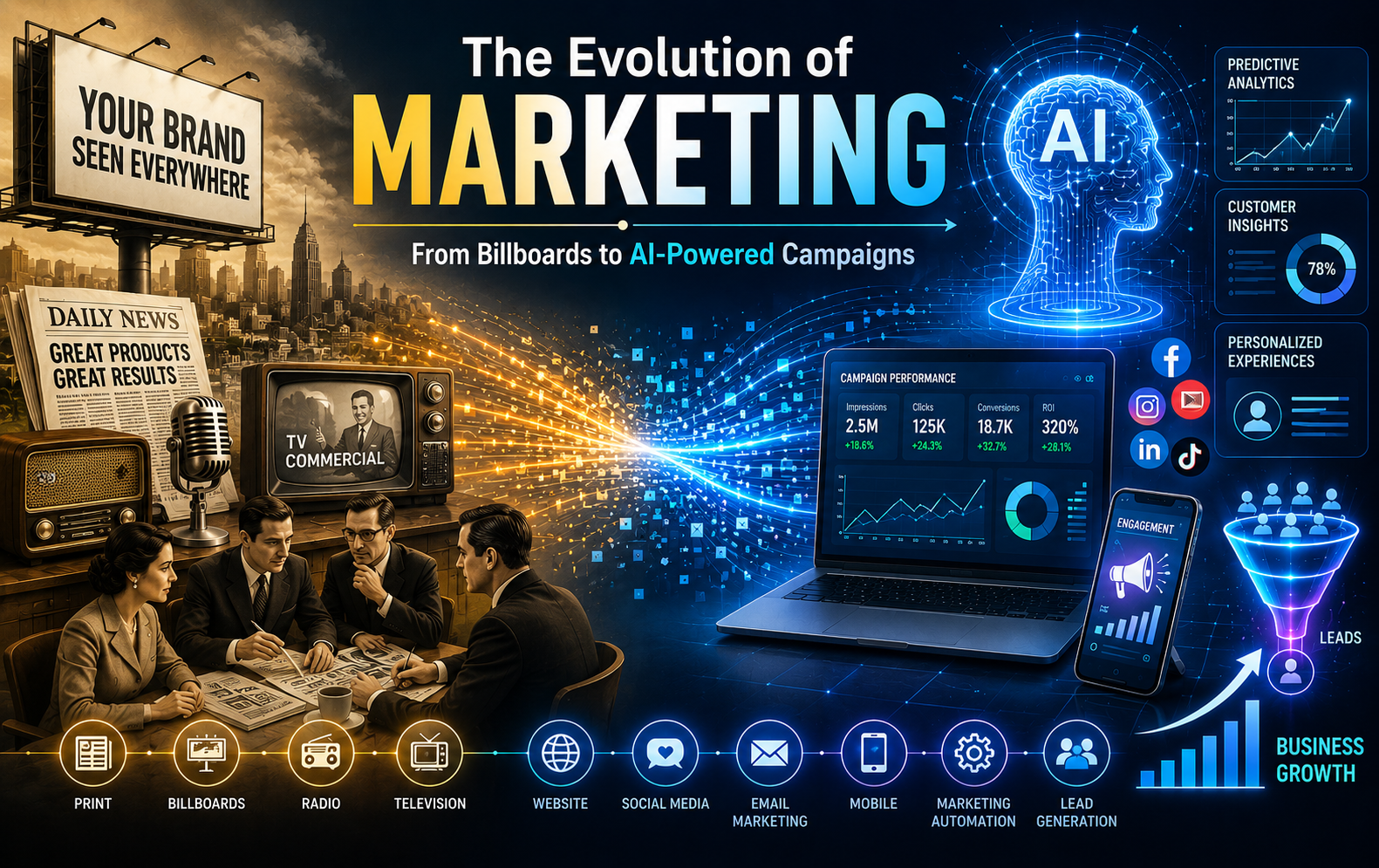
The Evolution of Marketing: From Billboards to AI-Powered Campaigns - Dizitude
In today’s fast-paced digital world, marketing has undergone a remarkable transformation. What once relied heavily on billboards, newspapers, radio advertisements, and television commercials has evolved into a sophisticated ecosystem powered by artificial intelligence, automation, and data analytics. This evolution has changed how businesses connect with customers, generate leads, and drive sustainable growth.
For businesses looking to stay competitive, understanding this shift is essential. Modern consumers expect personalized experiences, instant communication, and relevant content—demands that traditional marketing alone can no longer fully satisfy.
The Foundation: Traditional Marketing
For decades, traditional marketing served as the primary method for promoting products and services. Businesses invested heavily in print advertisements, outdoor billboards, direct mail campaigns, radio spots, and television commercials to reach large audiences.
Billboards, in particular, became iconic marketing tools. Positioned in high-traffic locations, they provided brands with widespread visibility and helped establish strong brand recognition. Television and radio advertisements enabled businesses to communicate with millions of potential customers simultaneously.
While traditional marketing offered broad reach and brand awareness, it came with several limitations. Measuring campaign performance was difficult, audience targeting was limited, and advertising costs were often high. Businesses frequently relied on assumptions rather than concrete data to evaluate success.
As technology advanced and consumer behavior shifted online, marketers began searching for more effective ways to engage audiences and maximize return on investment.
The Digital Marketing Revolution
The rise of the internet revolutionized the marketing industry. Businesses no longer had to rely solely on mass-market advertising to reach potential customers. Websites became digital storefronts, while search engines created new opportunities for brands to be discovered online.
This marked the beginning of modern digital marketing services, including Search Engine Optimization (SEO), Pay-Per-Click (PPC) advertising, email marketing, and content marketing.
Unlike traditional advertising, digital marketing allowed businesses to track customer behavior in real time. Marketers could measure website traffic, monitor user engagement, analyze conversion rates, and optimize campaigns based on actual performance data.
The ability to measure results transformed marketing from an art based largely on intuition into a science driven by data and analytics.
Social Media and Customer Engagement
The emergence of social media platforms further accelerated marketing’s evolution. Platforms such as Facebook, Instagram, LinkedIn, YouTube, and X (formerly Twitter) gave businesses direct access to billions of users worldwide.
Social media marketing enabled brands to engage with audiences in real time, build communities, and foster meaningful relationships with customers. Businesses could now create targeted campaigns based on demographics, interests, online behavior, and purchasing habits.
This shift introduced new marketing opportunities, including influencer marketing, video marketing, and user-generated content. Brands were no longer simply advertising—they were creating experiences and conversations.
The result was greater customer engagement, stronger brand loyalty, and more effective lead generation strategies.
The Rise of Marketing Automation
As businesses collected larger volumes of customer data, managing marketing activities manually became increasingly challenging. This led to the rise of marketing automation.
Marketing automation platforms help businesses streamline repetitive tasks such as email campaigns, customer segmentation, lead nurturing, and performance tracking. Automated workflows ensure that potential customers receive the right message at the right time, improving conversion rates and customer experiences.
Customer Relationship Management (CRM) systems also became critical tools for organizing customer information and supporting personalized marketing strategies.
By leveraging automation, businesses can improve efficiency, reduce operational costs, and scale their marketing efforts more effectively.
AI-Powered Marketing: The Future Is Here
Today, Artificial Intelligence (AI) is transforming marketing faster than any previous technological advancement. AI-powered marketing enables businesses to analyze massive amounts of data, predict customer behavior, personalize content, and optimize campaigns with unprecedented accuracy.
AI technologies are now being used for:
Predictive customer analytics
Personalized product recommendations
AI chatbots and virtual assistants
Automated content creation
Smart advertising optimization
Customer journey mapping
Advanced lead generation
One of the greatest advantages of AI marketing is personalization at scale. Businesses can deliver highly relevant content and offers to individual customers without requiring extensive manual effort.
AI also helps marketers identify trends, forecast customer needs, and make data-driven decisions that improve marketing performance and return on investment.
How Dizitude Helps Businesses Grow Faster with AI-Driven Marketing
As the marketing landscape continues to evolve, businesses need a strategic partner that understands both technology and consumer behavior. Dizitude is an AI-driven digital marketing agency that helps businesses leverage advanced marketing techniques to accelerate growth and maximize results.
Dizitude combines innovative digital marketing services with cutting-edge AI technologies to create customized growth strategies for businesses across industries. From SEO and content marketing to social media management, performance advertising, lead generation, and marketing automation, Dizitude delivers data-driven solutions designed to increase visibility, attract qualified prospects, and boost conversions.
By utilizing AI-powered analytics, audience targeting, campaign automation, and real-time performance optimization, Dizitude helps businesses make smarter marketing decisions while reducing wasted advertising spend.
Whether you’re a startup, a growing business, or an established enterprise, Dizitude provides scalable marketing solutions that drive measurable business growth in today’s competitive digital marketplace.
The journey from traditional billboards to AI-powered campaigns reflects one of the most significant transformations in business history. While traditional marketing continues to play an important role in building brand awareness, modern digital marketing offers unparalleled opportunities for targeting, personalization, automation, and measurable results.
The future belongs to businesses that embrace innovation and leverage advanced technologies to better understand and serve their customers. By partnering with an experienced AI-driven marketing agency like Dizitude, businesses can stay ahead of industry trends, generate more leads, improve customer engagement, and achieve faster, sustainable growth.
In the modern era, marketing is no longer just about reaching people—it’s about reaching the right people, with the right message, at the right time.
Related Posts
Leave a Reply
Your email address will not be published.

Email Marketing: Best Practices to Boost Your Campaign's Success
Email marketing is a powerful digital marketing strategy that involves sending targeted emails to a group of individuals who have opted in to receive communication from your business. It is an effective way to build relationships with customers, drive engagement, and generate sales. Here are some key tips for successful email marketing:
Build a quality email list
Building a quality email list is the foundation of successful email marketing. Instead of buying email lists, focus on organically growing an engaged and opt-in subscriber base. Offer valuable content or incentives to encourage people to subscribe to your emails. You can use sign-up forms on your website, social media channels, or landing pages. Remember to obtain explicit permission to send emails and provide an easy way for subscribers to opt-out if they wish.
Segment your email list
Segmentation is crucial for delivering personalized and targeted emails. Divide your email list into different segments based on demographics, behavior, purchase history, or engagement levels. This allows you to create highly relevant and personalized email content for each segment. By sending tailored messages, you increase the chances of engagement and conversions.
Craft compelling subject lines
The subject line is the first thing recipients see in their inbox. It plays a significant role in determining whether they open your email or not. Craft compelling subject lines that are concise, clear, and enticing. Use personalization by including the recipient's name or referencing their previous interactions. Consider creating a sense of urgency, asking a question, or offering a benefit. Avoid misleading or spammy subject lines, as they can harm your reputation and lead to high unsubscribe rates.
Create valuable and relevant content
Your email content should provide value and relevance to your subscribers. Tailor your content based on their interests, needs, and stage in the customer journey. Share industry insights, tips, tutorials, or exclusive offers. Offer valuable information that solves problems or addresses pain points. Make your content easily scannable with headings, bullet points, and concise paragraphs. Use a conversational tone to establish a connection with your readers.
Use responsive and visually appealing designs
Ensure your emails are visually appealing and optimized for different devices, especially mobile. Use responsive design techniques to adapt the layout to various screen sizes. Keep your design clean and professional, with a clear hierarchy of information. Use eye-catching images, videos, or graphics that are relevant to your content. Be cautious with image-heavy emails, as some recipients may have images disabled by default. Include alt text for images and balance visuals with text.
Clear and prominent calls-to-action (CTAs)
Every email should have a clear and compelling call-to-action (CTA) that tells recipients what you want them to do next. Make your CTAs stand out by using contrasting colors, bold fonts, or buttons. Use actionable and persuasive language to encourage clicks. Ensure your CTA is relevant to the content of your email and leads to a landing page with a seamless user experience. Test different CTAs and placements to optimize their effectiveness.
Test and optimize your campaigns
Testing and optimization are essential for improving your email marketing performance. Conduct A/B tests to compare different elements of your emails, such as subject lines, CTAs, designs, or content. Test variables one at a time to identify what works best for your audience. Analyze key metrics like open rates, click-through rates, conversion rates, and unsubscribe rates to measure the impact of your changes. Use the insights gained to refine your strategies and continuously improve your campaigns.
Ensure deliverability and compliance
To ensure your emails reach the intended recipients, follow email deliverability best practices. Use a reputable email service provider (ESP) that maintains good relationships with ISPs and implements authentication protocols like SPF, DKIM, and DMARC. Regularly clean your email list to remove invalid or inactive email addresses. Monitor your sender reputation, avoid spam trigger words, and adhere to anti-spam regulations.
Remember, email marketing is an ongoing process that requires consistent effort and optimization. By understanding your audience, providing value, and leveraging personalization, you can create effective email campaigns that drive engagement, foster customer loyalty, and generate positive results for your business.

Content Marketing: Engage, Inform and Convert

In today's digital age, content marketing has become one of the most effective ways for businesses to reach and engage their target audience. Content marketing involves creating and sharing valuable, relevant, and consistent content to attract and retain a clearly defined audience - ultimately driving profitable customer action. In this article, we will discuss the key components of content marketing, and how it can help your business engage, inform, and convert.
Engage: The first step in content marketing is to engage your audience. Your content should be interesting, relevant, and provide value to your target audience. It's important to understand your audience's pain points, interests, and behaviors to create content that resonates with them. You can engage your audience through a variety of formats, such as blog posts, videos, social media posts, infographics, and more. By creating content that engages your audience, you can build brand awareness and loyalty.
Here are some steps you can follow to engage your audience through content marketing:
Know Your Audience
The first step in engaging your audience is to know who they are. Understand their needs, interests, pain points, and what motivates them. This information will help you create content that resonates with them and provides value.
Choose the Right Content Formats
Different types of content formats can appeal to different types of audiences. For example, some people may prefer to read blog posts, while others may prefer to watch videos. Consider your audience's preferences and choose the content formats that are most likely to engage them.
Create Quality Content
The quality of your content is essential in engaging your audience. Ensure that your content is well-written, informative, and easy to understand. Use visuals, such as images, infographics, and videos, to make your content more engaging.
Use Attention-Grabbing Headlines
Your headlines should grab your audience's attention and entice them to read your content. Use powerful, benefit-driven headlines that address your audience's needs or pain points.
Provide Value
Your content should provide value to your audience. Give them information, insights, or solutions that help them solve a problem or achieve their goals. By providing value, you build trust with your audience and establish your authority in your industry.
Be Consistent
Consistency is key in content marketing. Create a content calendar and publish content on a regular basis. This will help you build momentum, stay top-of-mind with your audience, and build a loyal following.
Promote Your Content
Once you create content, you need to promote it to ensure that it reaches your target audience. Use social media, email marketing, and other channels to promote your content and increase its visibility.
Inform: Once you've captured your audience's attention, it's important to inform them. Your content should be informative, educational, and provide value to your audience. By providing valuable information, you can establish your business as an authority in your industry. You can inform your audience by creating how-to guides, case studies, white papers, and more. By providing valuable information, you can build trust with your audience and establish your business as a thought leader.
Here are some steps you can follow to inform your audience through content marketing:
Conduct Research
Before you create content, conduct research on the topics that your audience is interested in. Use keyword research, social media listening, and surveys to understand the topics, questions, and concerns that your audience has. This will help you create content that is relevant and valuable to them.
Use Facts and Data
Incorporating facts, statistics, and data into your content can help establish your authority and build trust with your audience. Use reputable sources and provide citations to back up your claims. This will help your audience understand and trust the information you are providing.
Be Clear and Concise
When creating content, be clear and concise in your messaging. Use simple language and avoid jargon or technical terms that may confuse your audience. Organize your content in a logical and easy-to-follow format that makes it easy for your audience to consume.
Address Common Questions and Concerns
Addressing common questions and concerns that your audience may have is a great way to inform them and provide value. Create content that answers frequently asked questions or addresses common misconceptions. This will help your audience better understand the topic and build trust with your brand.
Use Visuals
Using visuals such as images, infographics, and videos can make your content more engaging and informative. Visuals can help break up text and make complex information easier to understand.
Collaborate with Experts
Collaborating with content experts in your industry can help you provide valuable information to your audience. Invite experts to contribute to your blog, podcast, or video series. This will help you provide your audience with a unique perspective and establish your brand as a thought leader in your industry.
Use Examples
Using real-world examples can help your audience understand complex topics and apply the information to their own situations. Use case studies, examples, and success stories to illustrate your points and provide context to your audience.
Convert: The ultimate goal of content marketing is to convert your audience into customers. To do this, your content should include clear calls-to-action (CTAs) that encourage your audience to take the next step. Whether it's downloading a white paper, signing up for a newsletter, or making a purchase, your CTAs should be clear and compelling. By creating content that informs and engages your audience, you can increase the likelihood of conversions.
Here are some steps you can follow to convert your audience through content marketing:
Define Your Goals and Objectives
The first step in converting your audience is to define your goals and objectives. Identify the specific actions you want your audience to take, such as filling out a contact form, downloading an ebook, or making a purchase. This will help you create content that is designed to achieve these goals.
Create Content with a Call-to-Action
Creating content with a call-to-action (CTA) is essential to converting your audience. A CTA is a clear and specific instruction that tells your audience what action to take next. Use strong and persuasive language in your CTA to encourage your audience to take the desired action.
Use Social Proof
Social proof, such as customer reviews, case studies, and testimonials, can help build trust with your audience and convince them to take action. Incorporate social proof into your content to demonstrate the value of your products or services and to show your audience that others have had a positive experience with your brand.
Personalize Your Content
Personalizing your content can help make it more relevant and engaging to your audience. Use segmentation and targeting to deliver personalized content to specific groups within your audience. This can help increase engagement and conversions.
Optimize Your Landing Pages
Optimizing your landing pages can help improve your conversion rates. Use clear and concise messaging, strong CTAs, and visually appealing design to encourage your audience to take action. Ensure that your landing pages are mobile-friendly and load quickly to provide a seamless user experience.
Nurture Your Leads
Nurturing your leads through email marketing and other channels can help move them through the buyer's journey and increase your chances of conversion. Provide valuable content that is relevant to their interests and needs, and use CTAs to encourage them to take the next step.
Measure and Analyze Your Results
Measuring and analyzing your results is crucial to understanding the effectiveness of your content marketing efforts. Use analytics tools to track your website traffic, engagement rates, and conversion rates. Use this information to make data-driven decisions and optimize your content strategy.
In conclusion, content marketing is a powerful tool for businesses looking to engage, inform, and convert their target audience. By creating content that engages your audience, provides valuable information, and includes clear calls-to-action, you can build brand awareness, establish your business as an authority, and ultimately drive profitable customer action. Whether you're just getting started with content marketing or looking to take your strategy to the next level, it's important to focus on creating content that adds value to your audience.
