

Digitization
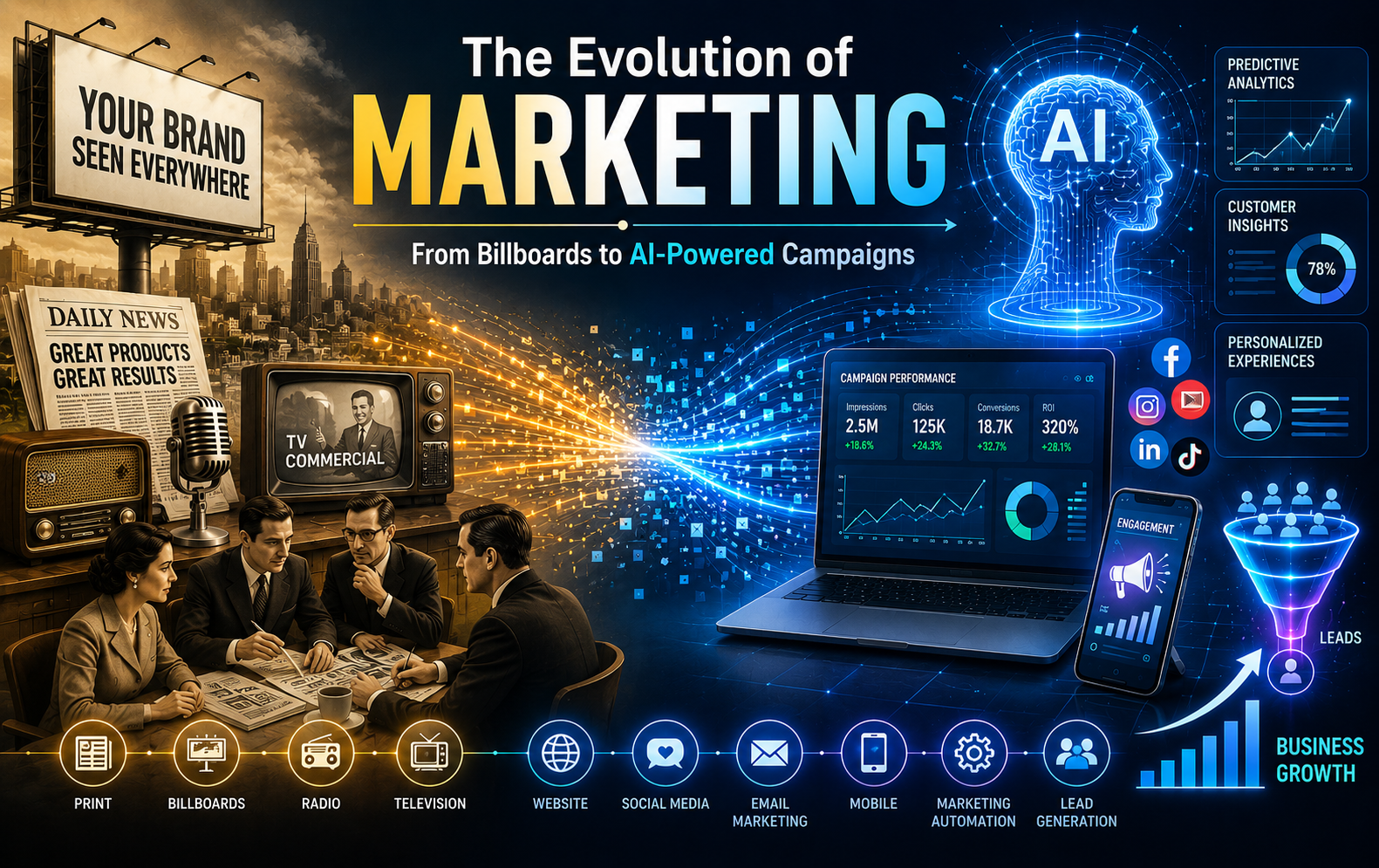
The Evolution of Marketing: From Billboards to AI-Powered Campaigns - Dizitude
In today’s fast-paced digital world, marketing has undergone a remarkable transformation. What once relied heavily on billboards, newspapers, radio advertisements, and television commercials has evolved into a sophisticated ecosystem powered by artificial intelligence, automation, and data analytics. This evolution has changed how businesses connect with customers, generate leads, and drive sustainable growth.
For businesses looking to stay competitive, understanding this shift is essential. Modern consumers expect personalized experiences, instant communication, and relevant content—demands that traditional marketing alone can no longer fully satisfy.
The Foundation: Traditional Marketing
For decades, traditional marketing served as the primary method for promoting products and services. Businesses invested heavily in print advertisements, outdoor billboards, direct mail campaigns, radio spots, and television commercials to reach large audiences.
Billboards, in particular, became iconic marketing tools. Positioned in high-traffic locations, they provided brands with widespread visibility and helped establish strong brand recognition. Television and radio advertisements enabled businesses to communicate with millions of potential customers simultaneously.
While traditional marketing offered broad reach and brand awareness, it came with several limitations. Measuring campaign performance was difficult, audience targeting was limited, and advertising costs were often high. Businesses frequently relied on assumptions rather than concrete data to evaluate success.
As technology advanced and consumer behavior shifted online, marketers began searching for more effective ways to engage audiences and maximize return on investment.
The Digital Marketing Revolution
The rise of the internet revolutionized the marketing industry. Businesses no longer had to rely solely on mass-market advertising to reach potential customers. Websites became digital storefronts, while search engines created new opportunities for brands to be discovered online.
This marked the beginning of modern digital marketing services, including Search Engine Optimization (SEO), Pay-Per-Click (PPC) advertising, email marketing, and content marketing.
Unlike traditional advertising, digital marketing allowed businesses to track customer behavior in real time. Marketers could measure website traffic, monitor user engagement, analyze conversion rates, and optimize campaigns based on actual performance data.
The ability to measure results transformed marketing from an art based largely on intuition into a science driven by data and analytics.
Social Media and Customer Engagement
The emergence of social media platforms further accelerated marketing’s evolution. Platforms such as Facebook, Instagram, LinkedIn, YouTube, and X (formerly Twitter) gave businesses direct access to billions of users worldwide.
Social media marketing enabled brands to engage with audiences in real time, build communities, and foster meaningful relationships with customers. Businesses could now create targeted campaigns based on demographics, interests, online behavior, and purchasing habits.
This shift introduced new marketing opportunities, including influencer marketing, video marketing, and user-generated content. Brands were no longer simply advertising—they were creating experiences and conversations.
The result was greater customer engagement, stronger brand loyalty, and more effective lead generation strategies.
The Rise of Marketing Automation
As businesses collected larger volumes of customer data, managing marketing activities manually became increasingly challenging. This led to the rise of marketing automation.
Marketing automation platforms help businesses streamline repetitive tasks such as email campaigns, customer segmentation, lead nurturing, and performance tracking. Automated workflows ensure that potential customers receive the right message at the right time, improving conversion rates and customer experiences.
Customer Relationship Management (CRM) systems also became critical tools for organizing customer information and supporting personalized marketing strategies.
By leveraging automation, businesses can improve efficiency, reduce operational costs, and scale their marketing efforts more effectively.
AI-Powered Marketing: The Future Is Here
Today, Artificial Intelligence (AI) is transforming marketing faster than any previous technological advancement. AI-powered marketing enables businesses to analyze massive amounts of data, predict customer behavior, personalize content, and optimize campaigns with unprecedented accuracy.
AI technologies are now being used for:
Predictive customer analytics
Personalized product recommendations
AI chatbots and virtual assistants
Automated content creation
Smart advertising optimization
Customer journey mapping
Advanced lead generation
One of the greatest advantages of AI marketing is personalization at scale. Businesses can deliver highly relevant content and offers to individual customers without requiring extensive manual effort.
AI also helps marketers identify trends, forecast customer needs, and make data-driven decisions that improve marketing performance and return on investment.
How Dizitude Helps Businesses Grow Faster with AI-Driven Marketing
As the marketing landscape continues to evolve, businesses need a strategic partner that understands both technology and consumer behavior. Dizitude is an AI-driven digital marketing agency that helps businesses leverage advanced marketing techniques to accelerate growth and maximize results.
Dizitude combines innovative digital marketing services with cutting-edge AI technologies to create customized growth strategies for businesses across industries. From SEO and content marketing to social media management, performance advertising, lead generation, and marketing automation, Dizitude delivers data-driven solutions designed to increase visibility, attract qualified prospects, and boost conversions.
By utilizing AI-powered analytics, audience targeting, campaign automation, and real-time performance optimization, Dizitude helps businesses make smarter marketing decisions while reducing wasted advertising spend.
Whether you’re a startup, a growing business, or an established enterprise, Dizitude provides scalable marketing solutions that drive measurable business growth in today’s competitive digital marketplace.
The journey from traditional billboards to AI-powered campaigns reflects one of the most significant transformations in business history. While traditional marketing continues to play an important role in building brand awareness, modern digital marketing offers unparalleled opportunities for targeting, personalization, automation, and measurable results.
The future belongs to businesses that embrace innovation and leverage advanced technologies to better understand and serve their customers. By partnering with an experienced AI-driven marketing agency like Dizitude, businesses can stay ahead of industry trends, generate more leads, improve customer engagement, and achieve faster, sustainable growth.
In the modern era, marketing is no longer just about reaching people—it’s about reaching the right people, with the right message, at the right time.
Related Posts
Leave a Reply
Your email address will not be published.

Effective Digital Marketing Strategies for Colleges and Schools for Building a Strong Brand Presence
Digital marketing has become an essential part of the education industry, as educational institutions strive to reach a wider audience and engage with potential students.
And Social media marketing has become an integral part of the education industry's digital marketing strategy. Educational institutions use social media platforms such as Facebook, Twitter, Instagram, LinkedIn, and YouTube to engage with prospective students, build brand awareness, and promote their programs.
Here are 20 benefits of social media marketing in the education industry:
- Increased visibility and brand awareness: Social media helps educational institutions to reach a wider audience and build their brand awareness.
- Improved communication: Social media platforms enable educational institutions to communicate with students, faculty, and staff in real-time.
- Cost-effective: Social media marketing is relatively cost-effective compared to traditional marketing methods.
- Targeted advertising: Social media platforms allow educational institutions to target their advertising to specific demographics, including age, location, interests, and more.
- Increased student engagement: Social media provides a platform for educational institutions to engage with prospective and current students and build relationships with them.
- Improved student recruitment: Social media can help educational institutions to attract and recruit more students.
- Increased website traffic: Social media can drive traffic to an educational institution's website, improving its online visibility.
- Better SEO: Social media activity can improve an institution's search engine rankings, making it easier for prospective students to find them.
- Enhanced reputation management: Social media can be used to manage an educational institution's online reputation management and respond to negative feedback.
- Opportunities for collaboration: Social media can facilitate collaboration between educational institutions and other organizations.
- Improved alumni relations: Social media provides a platform for educational institutions to stay in touch with their alumni and engage them in events and activities.
- Increased event attendance: Social media can be used to promote events, resulting in higher attendance.
- Improved student retention: Social media can help educational institutions to improve student retention rates by engaging with students and providing support.
- Increased donor engagement: Social media can help educational institutions to engage with donors and encourage donations.
- Improved crisis communication: Social media can be used for crisis communication, allowing educational institutions to quickly communicate with their community during a crisis.
- Opportunities for faculty engagement: Social media can provide faculty members with opportunities to share their research and engage with other professionals in their field.
- Improved community outreach: Social media can be used to engage with the wider community and build relationships with local organizations.
- Increased international student recruitment: Social media can be used to attract and recruit international students.
- Improved student success: Social media can be used to provide resources and support to students, improving their chances of success.
- Improved employee recruitment: Social media can be used to attract and recruit talented faculty and staff members.
Overall, digital marketing provides numerous benefits for educational institutions, helping them to reach a wider audience, improve their online presence, and engage with their community.
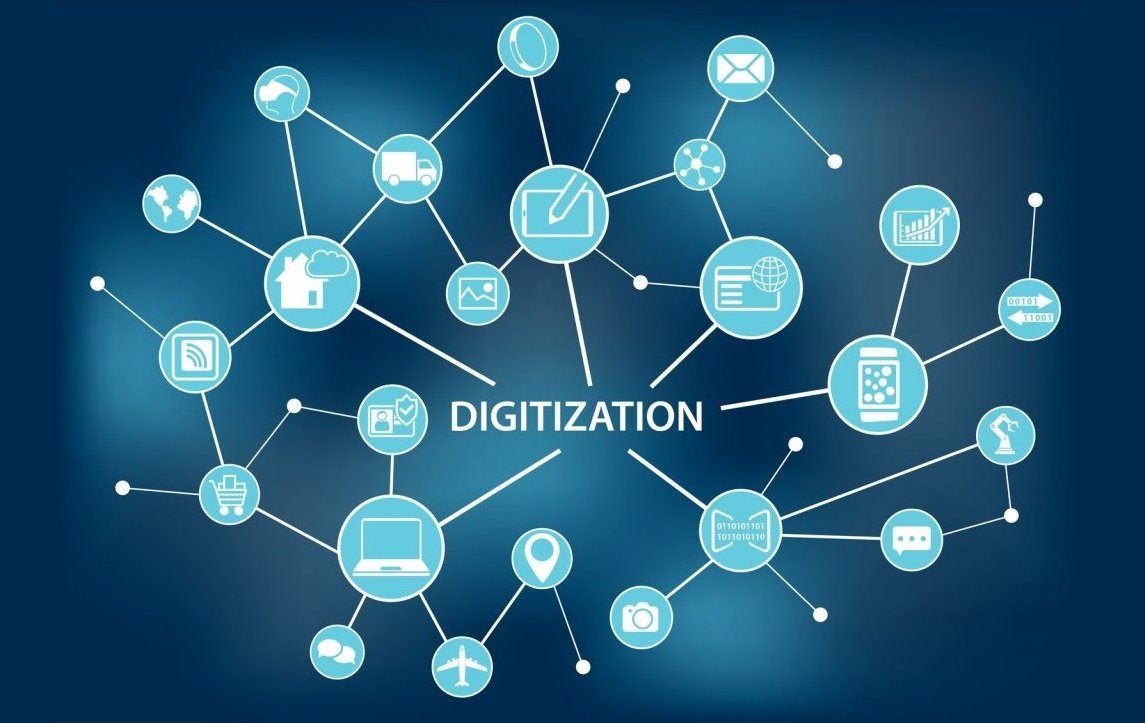
10 Unknown Benefits of Digitalization You Should Be Aware Of!
Organizations are seeking to incorporate digital technology in order to stay competitive, promote production and efficiency, and increase profit margins in this intensely competitive market. Because of its ability to induce significant revolutions in how organizations run through improving internal business processes, digitalization has taken the corporate world by storm.
Increased efficiency, productivity increases, lower operating costs, improved customer experiences, higher agility, enhanced staff morale, social inclusion, greater transparency, improved competitive edge, and speedier decision-making are just a few of the benefits of digitalization.
In this blog, we'll look at the benefits of digitization for businesses.
What exactly is digitalization?
The process of utilizing digital technology to modify a corporate model in order to increase revenue or value-added prospects is known as digitalization. It is the transition to digitalization.
It encompasses the process of adapting traditional methods of operation to new technologies that embrace the promise of digital technology to collect data, discover patterns, and make better business decisions.
Top 10 Benefits of Digitalization
Organizations all over the world are changing their operations to make them digitally compliant. Many organizations have recognized the value of digitalization and have already converted to or invested in new marketing strategies. Consider the following: communications, music, eBooks, and internet commerce.
It is common knowledge that firms must constantly adapt in order to remain viable. Organizations in today's digital world have no choice but to engage on the digitalization road.
Some of the benefits of digitization in business include increased efficiency, cost savings, and increased output. To summarize, it is literally a question of death and life for them.
The following are the top ten benefits of digitization:
1- Process Improvements
Every organization is constantly seeking new ways to increase efficiency. If you want to increase your business efficiency, you must begin on a digitalization path.
When a business procedure is automated, you should expect consistent results. Process automation and related company rules will assist your firm in achieving better openness and fairness.
Efficiency is described as the effective use of time, effort, and money to perform a task or accomplish a goal. One of the major benefits of digitization is that it reduces the amount of time it takes to perform a task, the amount of work required to complete it, and the expense of doing it correctly.
2- Increased Productivity
When simply automating manual repetitive operations, you relieve your staff from mundane job tasks and enable them to focus on more complex and innovative efforts that will help your organization run more efficiently.
Tasks can be completed more quickly and with fewer errors with the automation of business process solutions. Finally, process automation allows people to make greater use of their work time.
3- Reduce Operating Expenses
The goal of every business owner is to save hours and, more significantly, money. Because manual tasks and processes are performed one at a time, they are inherently slower than automated activities and processes.
Digitalization allows you to make the most efficient & cost-effective use of the primary resources.
4- Improve Transparency
Vital metrics can be collected and reported on to give you the critical information you require, based on the process you've chosen to automate (finance, billing, collections, sales, and/or support). Long-term success requires transparency in company procedures.
5- Consistency and quality
One of the most significant benefits of digitalization is that it ensures that each activity is performed consistently, resulting in high-quality, trustworthy output.
If you automate the customer service follow-up procedure, for example, your customers will always receive the same level of service from your organization.
Because of the certainty of quality and consistency, as well as the benefits of time and efficiency, you may develop a better understanding of higher-quality, greater feature-rich goods with little or no change in manufacturing time and costs.
6- Human Error is reduced
When procedures are automated, the possibility of human error is greatly reduced.
Humans are more likely to make mistakes than machines when performing jobs. Machines never tire and may operate continuously 24 hours a day. So let us delegate what we don't want to do to computers and focus on more difficult things.
7- Reliability and Governance
You can rely on automated processes since they are constant. Workflow automation's dependability ensures that important corporate governance operations were completed on time and in accordance with the law.
8- Increased Agility
Businesses must adapt to the fast-paced digital world now more than ever. They have to be able to react quickly to any market move, disruption, or fresh opportunity.
Organizations must be agile enough just to shift directions quickly, and to do so, agile approaches must be used throughout all departments.
9- Increased Employee Morale
Employees' ability to learn, grow, and advance professionally is hampered when they are obliged to focus on manually repetitive duties. Employees gain from digitization since it eliminates these monotonous tasks, allowing them to focus on more important efforts and therefore improving morale.
10- Improved decision-making
Information management and digitalization go hand in hand since knowledge is created through the analysis of information, which results in improved decisions.
