

Social Media Marketing
Digital Marketing & Tech-Driven Strategies Transforming the Real Estate Industry
The real estate sector is rapidly evolving, driven by digital innovation and technology-led marketing strategies. Today’s buyers are more informed, research-oriented, and digitally active—making it essential for real estate brands to adopt smarter, data-driven approaches to stay competitive.
Digital- Buyer Journey Mapping
Homebuyers now begin their search online. From Google searches and property portals to social media and virtual site visits, digital touchpoints play a crucial role in influencing decisions. A strong online presence ensures visibility at every stage of the buyer journey.
Data-Driven Marketing & Lead Targeting
Advanced analytics, CRM tools, and AI-powered platforms help developers and brokers understand buyer behavior, preferences, and intent. This enables精准 targeting through Google Ads, Meta platforms, and programmatic advertising, resulting in higher-quality leads and better ROI.
Immersive Visual Experiences
High-quality AVs, drone videos, 3D walkthroughs, virtual tours, and AR/VR experiences allow buyers to explore properties remotely. These tools not only build trust but also shorten decision cycles by offering realistic property visualization.
Marketing Automation & CRM Integration
Automated lead nurturing through emails, WhatsApp, chatbots, and CRM systems ensures timely follow-ups and personalized communication. This reduces manual effort and significantly improves conversion rates.
Tech-Enabled Sales & Transparency
Digital documentation, online bookings, virtual meetings, and e-KYC have made the buying process faster and more transparent. Buyers appreciate seamless, tech-enabled experiences that save time and offer clarity.
Social Media & Content Marketing
Storytelling through reels, short videos, testimonials, blogs, and influencer collaborations helps projects connect emotionally with buyers. Consistent content builds brand credibility and long-term engagement.
A tech-driven, digital marketing approach is no longer optional in real estate—it’s essential. Developers and real estate brands that embrace technology, data, and innovation are better positioned to attract modern buyers, accelerate sales, and build future-ready brands.
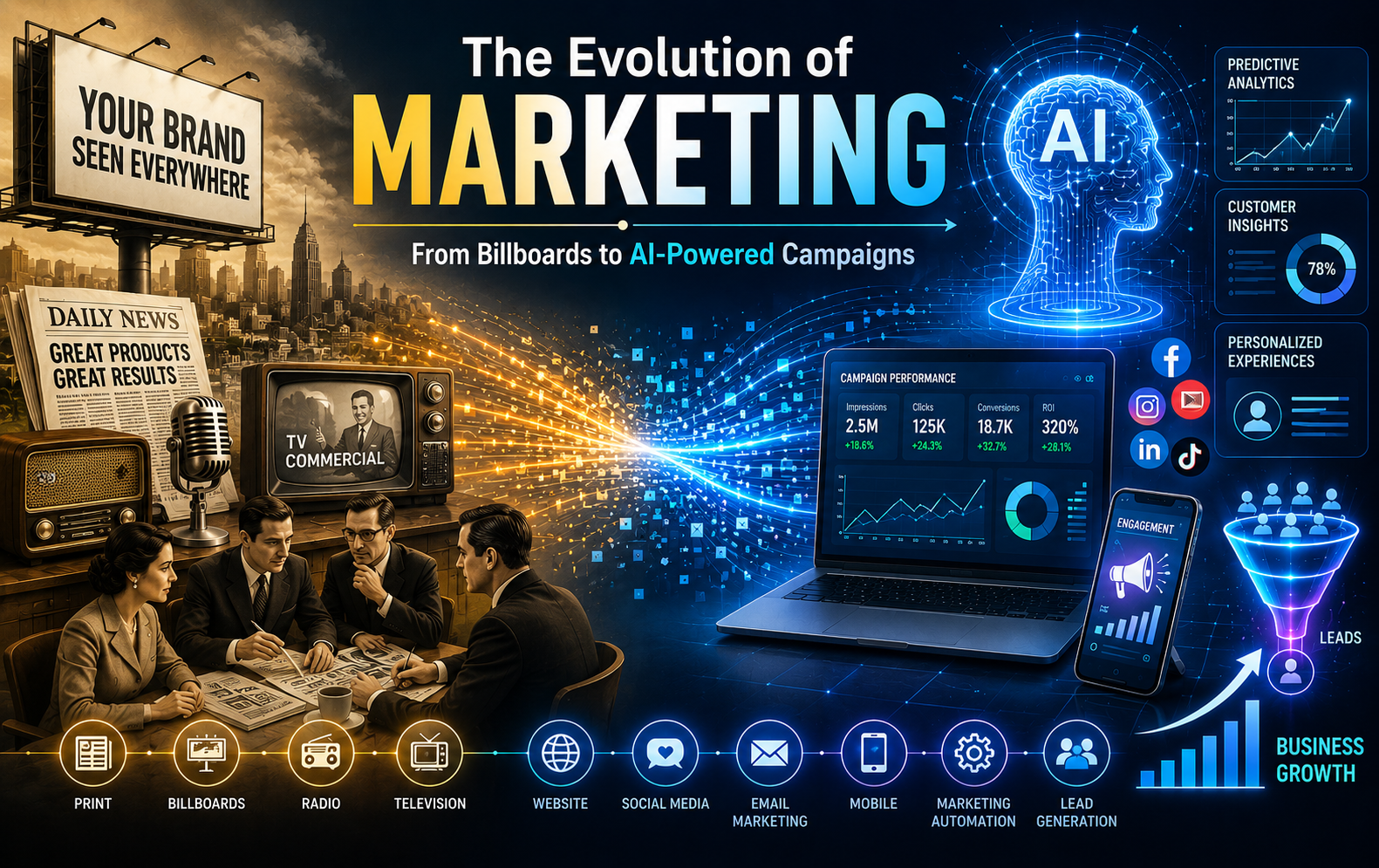
The Evolution of Marketing: From Billboards to AI-Powered Campaigns - Dizitude
In today’s fast-paced digital world, marketing has undergone a remarkable transformation. What once relied heavily on billboards, newspapers, radio advertisements, and television commercials has evolved into a sophisticated ecosystem powered by artificial intelligence, automation, and data analytics. This evolution has changed how businesses connect with customers, generate leads, and drive sustainable growth.
For businesses looking to stay competitive, understanding this shift is essential. Modern consumers expect personalized experiences, instant communication, and relevant content—demands that traditional marketing alone can no longer fully satisfy.
The Foundation: Traditional Marketing
For decades, traditional marketing served as the primary method for promoting products and services. Businesses invested heavily in print advertisements, outdoor billboards, direct mail campaigns, radio spots, and television commercials to reach large audiences.
Billboards, in particular, became iconic marketing tools. Positioned in high-traffic locations, they provided brands with widespread visibility and helped establish strong brand recognition. Television and radio advertisements enabled businesses to communicate with millions of potential customers simultaneously.
While traditional marketing offered broad reach and brand awareness, it came with several limitations. Measuring campaign performance was difficult, audience targeting was limited, and advertising costs were often high. Businesses frequently relied on assumptions rather than concrete data to evaluate success.
As technology advanced and consumer behavior shifted online, marketers began searching for more effective ways to engage audiences and maximize return on investment.
The Digital Marketing Revolution
The rise of the internet revolutionized the marketing industry. Businesses no longer had to rely solely on mass-market advertising to reach potential customers. Websites became digital storefronts, while search engines created new opportunities for brands to be discovered online.
This marked the beginning of modern digital marketing services, including Search Engine Optimization (SEO), Pay-Per-Click (PPC) advertising, email marketing, and content marketing.
Unlike traditional advertising, digital marketing allowed businesses to track customer behavior in real time. Marketers could measure website traffic, monitor user engagement, analyze conversion rates, and optimize campaigns based on actual performance data.
The ability to measure results transformed marketing from an art based largely on intuition into a science driven by data and analytics.
Social Media and Customer Engagement
The emergence of social media platforms further accelerated marketing’s evolution. Platforms such as Facebook, Instagram, LinkedIn, YouTube, and X (formerly Twitter) gave businesses direct access to billions of users worldwide.
Social media marketing enabled brands to engage with audiences in real time, build communities, and foster meaningful relationships with customers. Businesses could now create targeted campaigns based on demographics, interests, online behavior, and purchasing habits.
This shift introduced new marketing opportunities, including influencer marketing, video marketing, and user-generated content. Brands were no longer simply advertising—they were creating experiences and conversations.
The result was greater customer engagement, stronger brand loyalty, and more effective lead generation strategies.
The Rise of Marketing Automation
As businesses collected larger volumes of customer data, managing marketing activities manually became increasingly challenging. This led to the rise of marketing automation.
Marketing automation platforms help businesses streamline repetitive tasks such as email campaigns, customer segmentation, lead nurturing, and performance tracking. Automated workflows ensure that potential customers receive the right message at the right time, improving conversion rates and customer experiences.
Customer Relationship Management (CRM) systems also became critical tools for organizing customer information and supporting personalized marketing strategies.
By leveraging automation, businesses can improve efficiency, reduce operational costs, and scale their marketing efforts more effectively.
AI-Powered Marketing: The Future Is Here
Today, Artificial Intelligence (AI) is transforming marketing faster than any previous technological advancement. AI-powered marketing enables businesses to analyze massive amounts of data, predict customer behavior, personalize content, and optimize campaigns with unprecedented accuracy.
AI technologies are now being used for:
Predictive customer analytics
Personalized product recommendations
AI chatbots and virtual assistants
Automated content creation
Smart advertising optimization
Customer journey mapping
Advanced lead generation
One of the greatest advantages of AI marketing is personalization at scale. Businesses can deliver highly relevant content and offers to individual customers without requiring extensive manual effort.
AI also helps marketers identify trends, forecast customer needs, and make data-driven decisions that improve marketing performance and return on investment.
How Dizitude Helps Businesses Grow Faster with AI-Driven Marketing
As the marketing landscape continues to evolve, businesses need a strategic partner that understands both technology and consumer behavior. Dizitude is an AI-driven digital marketing agency that helps businesses leverage advanced marketing techniques to accelerate growth and maximize results.
Dizitude combines innovative digital marketing services with cutting-edge AI technologies to create customized growth strategies for businesses across industries. From SEO and content marketing to social media management, performance advertising, lead generation, and marketing automation, Dizitude delivers data-driven solutions designed to increase visibility, attract qualified prospects, and boost conversions.
By utilizing AI-powered analytics, audience targeting, campaign automation, and real-time performance optimization, Dizitude helps businesses make smarter marketing decisions while reducing wasted advertising spend.
Whether you’re a startup, a growing business, or an established enterprise, Dizitude provides scalable marketing solutions that drive measurable business growth in today’s competitive digital marketplace.
The journey from traditional billboards to AI-powered campaigns reflects one of the most significant transformations in business history. While traditional marketing continues to play an important role in building brand awareness, modern digital marketing offers unparalleled opportunities for targeting, personalization, automation, and measurable results.
The future belongs to businesses that embrace innovation and leverage advanced technologies to better understand and serve their customers. By partnering with an experienced AI-driven marketing agency like Dizitude, businesses can stay ahead of industry trends, generate more leads, improve customer engagement, and achieve faster, sustainable growth.
In the modern era, marketing is no longer just about reaching people—it’s about reaching the right people, with the right message, at the right time.
Related Posts
Leave a Reply
Your email address will not be published.
7 Strategic Ways to Boost Relevant Facebook Likes With Ads
When was the last time that you spoke with someone and learned that he doesn’t exist on Facebook? Been a while probably!
It’s pretty rare to find a person who isn’t aware of what Facebook is. Billions of users chose Facebook to reach out and connect with family and friends or even potential customers. Today, it has around 1 billion daily active users and the count doesn’t show any signs of slowing down.
Many companies have already identified the unprecedented potential of Facebook presence that’s why they dedicate momentous resources and time to craft influential social media presence. The number of likes your Facebook posts attract is one of the vital Facebook success metrics. You should also keep a strict eye on boosting the number of relevant Facebook fans.
If you target Facebook fans appropriately, then it will certainly help you to generate leads and get more business. The best and most effective way of achieving this target quickly is with Facebook ads. That’s what this blog will talk about in this post. Here are 7 effective ways to boost your number of relevant Facebook Likes with ads.
1. Incorporate Page Like Sponsored Stories
Try running page like sponsored stories. It is the easiest and workable way to boost Page Likes. These stories simply promote that “Friend X Likes Brand Y.” You will find such ads appearing anywhere on your system’s sidebar, mobile or desktop News feed etc.
These ads are meant to target only friends of Fans. They make you think that if your friend likes something, then maybe you should also like the same. These ads try to build pressure on your mind to considering using those offerings once. They act as social proof!
2. Use Relevant and Basic Targeting to Improve Ads Performance
Targeting is plays pivotal role in deciding fate of an ad campaign. It can make or break your ad campaign. Relevant targeting can dramatically improve the performance of your Facebook ad. You must ensure that you implement the basic targeting when setting up a Facebook ad.
You can always segregate potential fans from those who aren’t bothered about your brand. Here are some of the ways you can isolate the target audience:
- Geography (Country, state/province, city, zip code)
- Age
- Gender
- Income
- Languages
- Workplaces
- Interested in (All, men or women)
- Relationships Basis
- Education (Anyone, postgraduate, graduate, in college, in high school)
3. Narrow down your audience Using Precise Interest Category Targeting
You can narrow down your audience targeting by entering a few relevant keywords, brands, and phrases within Precise Interests.
Ensure you keep your ideal customer in mind and the things that interest them. You may also target your audience using a couple of broad categories if you don’t wish to enter a relevant phrase.
It is advisable to use one of them either Precise Interests or Broad Categories but not both. Use Precise Interests for better targeting.
4. Try Running Marketplace Ads
You will find a marketplace ad unit appearing within the sidebar. In contrast to a sponsored Story, market place ads allow customization in terms of the title, copy and imagery.
Such kind of ad is thought- provoking and offers room for split testing and optimization. It’s advisable that you should try a different variation of targeting and creativity to know what works best for you.
5. Try running Facebook Sponsored Search Ads
Use Facebook Sponsored Search results especially if your audience is in the initial growth stage. This way you will be able to target more relevant Facebook Pages that users are most likely to search. Don’t forget to keep in mind the kinds of Pages your ideal customer likes.
6. Target Your Email List
If you have an established email list, you have got all the autonomy to leverage that list with custom audiences. This way you can focus on expanding your Facebook page reach.
It is suggested that you should target those members on your list who are currently not Fans with a search ad or marketplace. This is majorly done to remind them to like your Facebook Page. Your conversion rate is going to be high if your list is the quality list.
7. Target Similar Audiences
One of the easy ways of expanding your email list (which is high quality but small) is by targeting similar audiences. This will enable you to target potential fans that are similar to people present on your email list.
After entering the power editor, you need to click on your list and then create a similar audience. Doing this will enable Facebook to find users who either lie within the top 1% or 5% category of similarity as compared to your list.
The Bottom Line
Everyone wants more Facebook likes, shares, comments, followers and fans. Marketers are a bit more obsessed with these since powerful Facebook presence helps them promote their business and expand reach. Facebook Ads can work wonders for your business. If you don’t see the business coming in from boosting relevant Facebook likes, start using these tricks to narrow down your target audience and attract more business.
